
Kawasaki Disease
Kawasaki disease (KD) is an acute inflammatory condition that predominantly affects children under 5 years of age and presents with multisystem involvement. It is a form of vasculitis characterized by severe cardiac complications in the absence of appropriate treatment. The most dangerous complications include the formation of coronary artery aneurysms with a subsequent risk of thrombosis, rupture, myocardial infarction, and the development of acute cardiovascular failure, which may lead to death during the acute phase of the disease or later in life at any age.
KD shares clinical features with many diseases from different categories, including infectious, autoimmune, hematological, and surgical conditions. Given that the disease is self-limiting, it may resolve spontaneously even without specific treatment; however, in such patients, the frequency of coronary artery involvement is approximately 25%.
The generally accepted treatment is the administration of intravenous human normal immunoglobulin (IVIG) at an immunosuppressive (immunomodulatory) dose of 2 g/kg, which should be given within the first 10 days of illness as a single infusion lasting no more than 12 hours. Adjunctive therapy includes the administration of acetylsalicylic acid (aspirin). However, approximately 25% of children exhibit resistance to IVIG. This cohort of patients requires second- or even third-line therapy. Possible therapeutic options for second- and third-line treatment include repeated IVIG administration at a dose of 2 g/kg with and/or without the addition of glucocorticosteroids, including “pulse” doses; the use of tumor necrosis factor-alpha (TNF-α) inhibitors (infliximab) or interleukin-1 beta inhibitors (anakinra), or other immunosuppressive agents such as cyclosporine A. The optimal treatment regimen in cases of IVIG resistance remains a matter of debate.
The etiology of KD remains incompletely understood. It is believed that the disease develops as a result of exposure to as yet unidentified infectious or non-infectious environmental triggers in individuals with a genetic predisposition. KD is most frequently reported among Japanese children, with an incidence of up to 359 cases per 100,000 children under 4 years of age, and is also common among populations in Taiwan (up to 60 cases) and China (up to 107 cases per 100,000), respectively. Among the White population, the average incidence is approximately 9 (4–15) cases per 100,000 children under 5 years of age.
In Ukraine, KD has predominantly been and remains a rare disease. In the Ukrainian medical literature, only isolated clinical case reports have been published (see below).
Epidemiological data from European countries indicate that KD represents a challenge for many healthcare systems and is highly dependent on physician awareness of the disease. The incidence of KD in Europe is approximately 10–15 per 100,000 children under 5 years of age among countries that publish statistical data. The reported rates vary widely: in Italy, the incidence reaches 17.6 per 100,000, whereas in the Czech Republic it is the lowest, at 1.6 per 100,000. These differences are often related to the level of diagnostic awareness and research methodology rather than true variations in disease prevalence. At the same time, a large number of countries, including those in the Balkan and Central European regions, have not published prevalence data. The minimum estimated incidence of KD in Ukraine is 4.6 per 100,000 children under 5 years of age (based on observations of KD cases in Kyiv during 2014–2016). It is likely that hundreds of children with KD remain undiagnosed in Ukraine each year.
Globally, the widely accepted guidelines are the 2017 American Heart Association (AHA) recommendations for the diagnosis of KD and its atypical (incomplete) form, as well as the updated 2024 AHA guidelines. Kawasaki disease is primarily a clinical diagnosis. Certain laboratory parameters and echocardiographic findings are used for diagnostic verification. The symptoms of KD may appear asynchronously and vary in duration, which often complicates diagnosis. The highest-risk group includes infants under 6 months of age, in whom the disease often presents with a limited number of symptoms.
Both underdiagnosis and overdiagnosis are characteristic of KD. However, the criteria for complete and incomplete KD are relatively strict and, in the majority of cases, allow differentiation of KD from other diseases.
Given the severe complications associated with KD, the following principle applies: “Treat first, then diagnose.” The absence of abnormalities on echocardiography in the presence of a well-founded suspicion of KD does not exclude the diagnosis.
Classic criteria for Kawasaki disease
Fever ≥5 days plus 4 of the following signs:
Bilateral conjunctivitis (80–90% of cases);
Changes in the oropharyngeal mucosa: injected and/or cracked lips, “strawberry tongue,” enanthema (80–90% of cases);
Palmar and/or plantar erythema or edema and/or periungual desquamation during the convalescent phase (80–90% of cases);
Polymorphous non-vesicular rash, especially on the trunk (>90% of cases);
Cervical lymphadenopathy (at least one lymph node >1.5 cm) (50% of cases).
Diagnostic Criteria and Management Algorithm for Incomplete Kawasaki Disease
Days of Awareness for Kawasaki Disease in Ukraine
Since 2018, the NGO “All-Ukrainian Association of Pediatric Immunology” has been regularly organizing Kawasaki Disease Awareness Days with the aim of improving disease diagnosis, ensuring timely identification of patients, and preventing severe cardiac complications.
In 2018 and 2019, clinical conferences dedicated to Kawasaki disease were held for healthcare professionals in Kyiv at the premises of the Kyiv City Children’s Clinical Hospital No. 1, in cooperation with the Department of Pediatric Infectious Diseases and Pediatric Immunology of the Shupyk National Healthcare University of Ukraine.


At the beginning of 2019, clinical conferences titled “Kawasaki Disease Awareness Days” were held in the cities of Chernivtsi


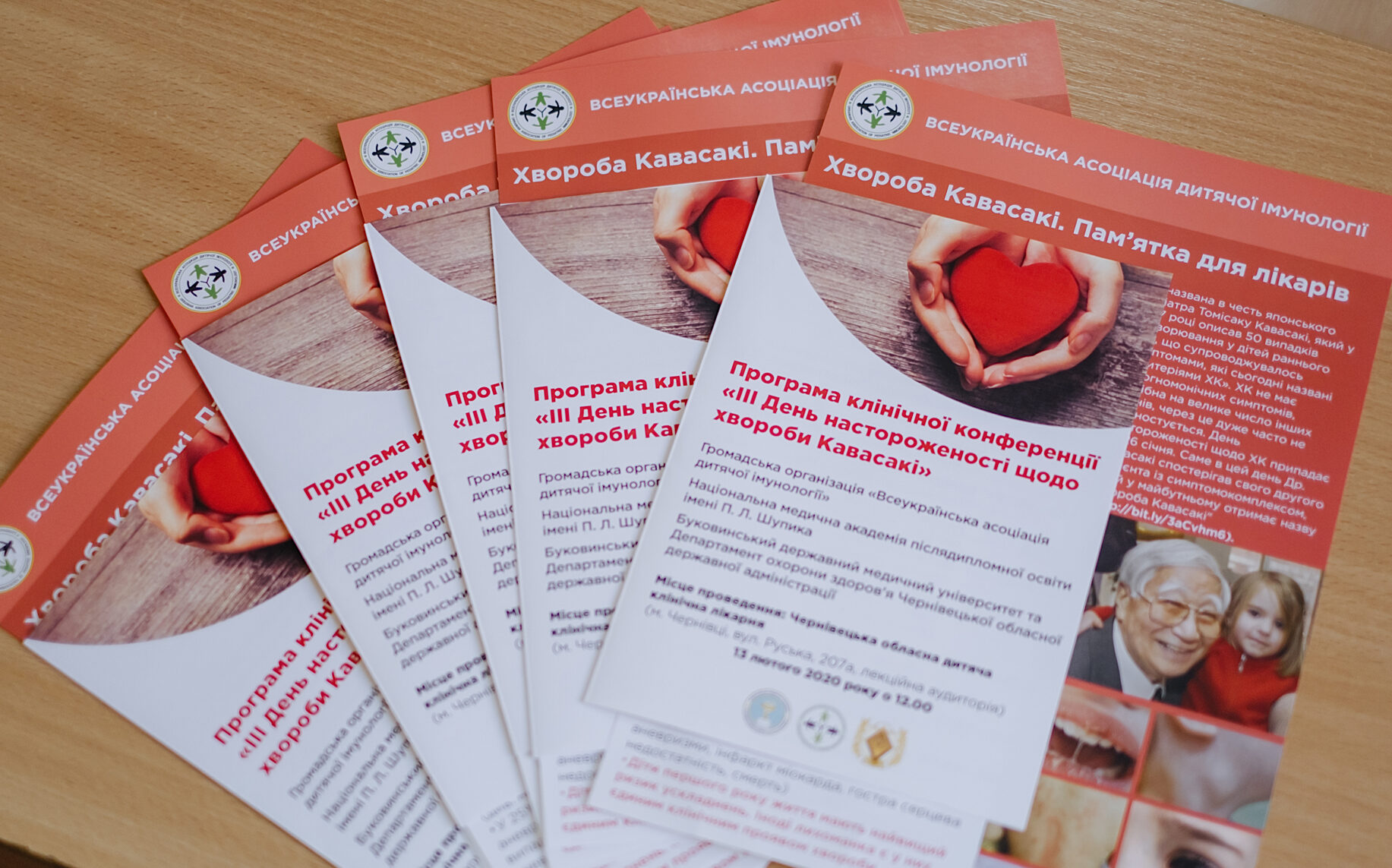

and Ternopil.


During the COVID-19 pandemic, the “Kawasaki Disease Awareness Days” transitioned to an online format.
“Kawasaki Disease” Webinar – June 9, 2020
Program of the Webinar
The June 9, 2020 webinar was dedicated to the memory of the Japanese physician Tomisaku Kawasaki, who passed away on June 5 at the age of 95. The invited speaker for this webinar was Jane Burns, Director of the Kawasaki Disease Research Center in San Diego, USA, and one of the world’s leading experts on Kawasaki disease.

January 26 was designated as Kawasaki Disease Awareness Day to honor the legacy of Dr. Tomisaku Kawasaki, the Japanese pediatrician who first identified and described the disease in 1967. He published a study of 50 pediatric cases presenting with a symptom complex previously known as “mucocutaneous lymph node syndrome,” which later became known as “Kawasaki disease.”
This date serves as a reminder of the importance of timely recognition and diagnosis of KD. Dr. Kawasaki’s work had a profound impact on pediatrics and continues to play a key role in the global understanding and management of this disease. The Awareness Day not only commemorates his memory but also encourages educational and advocacy efforts to improve care for children worldwide.
Educational activities rapidly proved their effectiveness and underscored the need for their continuation and for keeping the information up to date.
Recording of the February 11, 2021 Webinar: “Kawasaki Disease Awareness Day: Update”
The guest of the February 11 webinar was the Japanese physician Yoshihiro Nagao, who not only supported our conference but also delivered an outstanding presentation in the Ukrainian language.
Program of the Webinar, February 11, 2021
The clinical conferences evolved into the first symposium in Ukraine dedicated to Kawasaki disease, held in Lviv in a hybrid online–offline format at the Lviv “Okhmatdyt” Children’s Hospital, 12 days prior to the full-scale Russian invasion. The invited speakers were Yoshihiro Nagao (Japan) and Christian Hedrich (United Kingdom).
Symposium on “Kawasaki Disease in the Era of the COVID-19 Pandemic,” Lviv, February 12, 2022


Symposium Program – February 12, 2022
Quick Reference for Physicians – Download
Publications on Kawasaki Disease in Ukraine*
*If you have any publications on Kawasaki disease in Ukraine, please contact us at info@vadi.org.ua so that we may include them on our website.