
Inborn Errors of Immunity (IEI), or Primary Immunodeficiencies, are genetic disorders caused by pathogenic variants (mutations) in individual genes (monogenic diseases).
Since 1970, an expert committee under the auspices of the International Union of Immunological Societies (IUIS) has periodically updated the classification of primary immunodeficiencies. These updates aim to summarize genetic advancements and create a catalog of IEIs for clinicians and researchers.
2024 Data Update:
- 63 new IEIs and 2 phenocopies have been added.
- The total now stands at 555 monogenic IEIs and 17 phenocopies, with mutation variants identified in 504 genes.
To access the updated classification, refer to official IUIS publications or check recent issues of leading immunology journals such as The Journal of Clinical Immunology or Frontiers in Immunology.
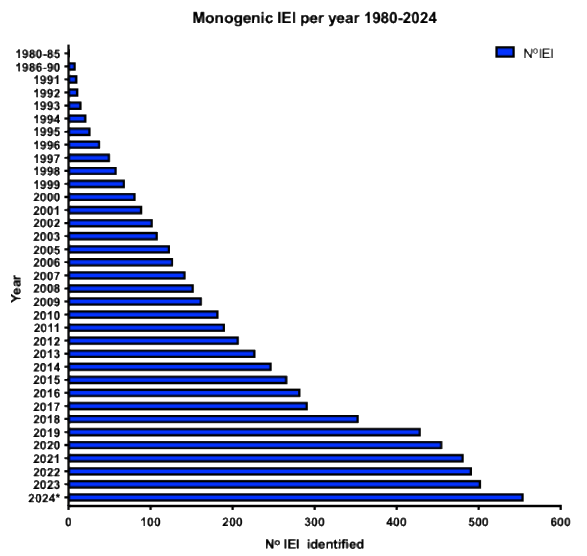
Although individual IEIs are rare, collectively, they pose a significant burden on healthcare systems. For example, in the United States, the prevalence of IEIs is 6 per 10,000 individuals.
Genetic Mechanisms Include:
- “Null” variants (complete loss of function) or hypomorphic variants (limited function);
- Gain-of-function (GOF) mutations (acquiring or increasing function);
- Loss-of-function (LOF) mutations (loss of function);
- Neomorphic variants (new functions).
Types of Inheritance:
- Monoallelic variants: Haploinsufficiency, dominant-negative effects, or GOF effects.
- Biallelic variants: Autosomal recessive traits caused by homozygous or compound heterozygous mutations.
- X-linked variants: Primarily affect males in a hemizygous state or females in a homozygous state.
CLINICAL MANIFESTATIONS OF INBORN ERRORS OF IMMUNITY:
- Increased susceptibility to infections;
- Autoimmune manifestations;
- Autoinflammation;
- Allergic symptoms;
- Bone marrow failure;
- Increased risk of malignancies.
One Gene — Multiple Phenotypes
Variants of the same gene can lead to diverse clinical manifestations depending on the type of mutation (LOF, GOF, neomorphic), the number of mutations, and their location within the gene.
SIGNIFICANCE FOR CLINICAL PRACTICE:
This classification serves as a reference not only for immunologists and geneticists but also for:
- Rheumatologists
- Hematologists
- Allergists
- Dermatologists
- Neurologists
- Gastroenterologists
- Pulmonologists
- Other specialists
STRUCTURE OF THE CLASSIFICATION OF INBORN ERRORS OF IMMUNITY:
Diseases are categorized into 10 major tables based on their clinical and immunological phenotypes:
- Combined immunodeficiencies
- Syndromic immunodeficiencies
- Predominantly antibody deficiencies
- Immune dysregulation disorders
- Congenital phagocyte defects
- Defects in intrinsic/innate immunity
- Autoinflammatory diseases
- Complement deficiencies
- Bone marrow failure syndromes
- Phenocopies of IEI
Nearly 46% of newly identified genes in the past year are associated with autoinflammation or immune dysregulation.
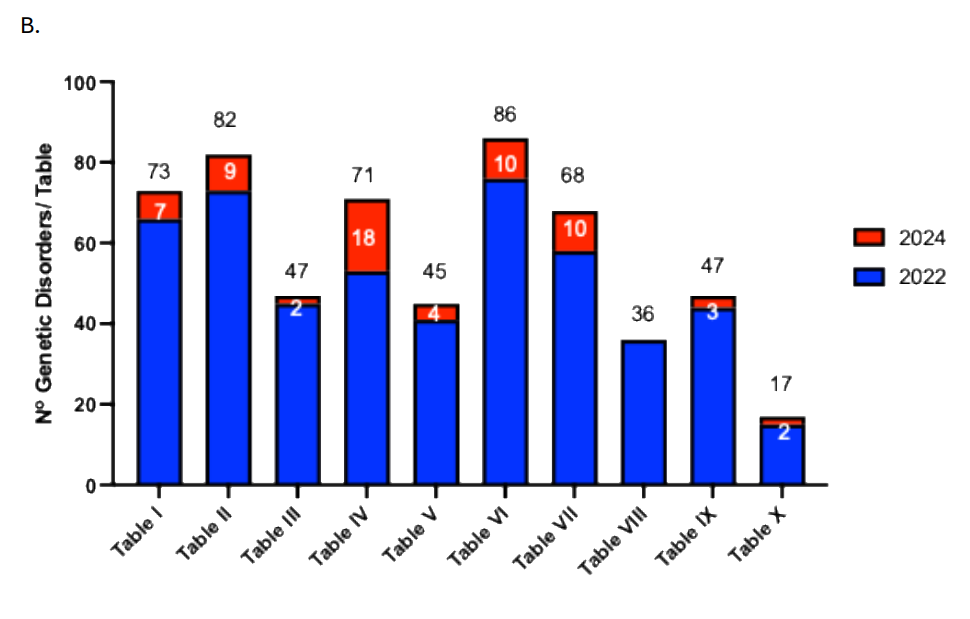
The discovery of new genes highlights the presence of numerous overlap symptoms and syndromes between PIDs and rheumatic diseases, necessitating genetic testing for patients with rheumatic conditions, especially in childhood.
Phenocopies of PIDs:
Phenocopies occur when mutations in different genes cause similar clinical manifestations, often through shared molecular mechanisms and pathways. Identifying phenocopies helps to understand critical processes such as DNA replication, metabolism, and immune gene recombination.
The updated 2024 classification demonstrates rapid progress in immunogenetics, particularly in the fields of autoimmunity, autoinflammation, immune dysregulation, and somatic mutations. These new findings further emphasize the connection between PIDs and autoimmune and rheumatic conditions, guiding improved diagnostics, interdisciplinary research, and targeted therapy.
Integration of genetics into clinical practice is crucial for understanding the complexity of immune disorders